
 English
 русский
 Español
 Deutsch

Field Guide — Brake Systems
A quiet mechanical failure that redefines everything about how a vehicle stops. Here is what actually happens beneath the wheel when adjustment goes wrong — and how to read the signs before the road does.
The Direct Answer
When a slack adjuster fails to adjust properly, the brake shoes or pads move too far away from the drum or rotor before making contact. This is called excessive brake stroke, and it directly reduces braking force, increases stopping distance, and can cause uneven braking across the axle. In severe cases, the wheel may not brake at all, which creates a serious risk of brake fade, trailer sway, or complete brake failure during heavy load or downhill driving. On vehicles equipped with a slack adjuster trailer setup, a single malfunctioning unit can throw off the entire trailer's braking balance, since trailer brakes are designed to work as a synchronized system.
The good news is that most of these failures are preventable. Understanding exactly what goes wrong mechanically, how to spot it early, and how to respond can protect both the vehicle and everyone on the road around it.
What Happens Mechanically When Adjustment Fails
A slack adjuster is the lever-shaped component that translates the linear push of the brake chamber pushrod into rotational force that applies the brake shoes against the drum. As brake linings wear down over thousands of miles, the distance the pushrod must travel to apply the brakes increases. The slack adjuster's job is to compensate for that wear so the stroke length stays within a safe operating range.
When this compensation stops working, the pushrod has to travel further and further to engage the brakes. This is measured as brake chamber stroke, and most heavy vehicle regulations require it to stay under a specific limit, typically between 1.75 and 2.5 inches depending on chamber size. Once stroke exceeds that limit, the brake is considered out of adjustment, meaning it can no longer generate full braking torque even when the driver presses the pedal firmly.
slack adjuster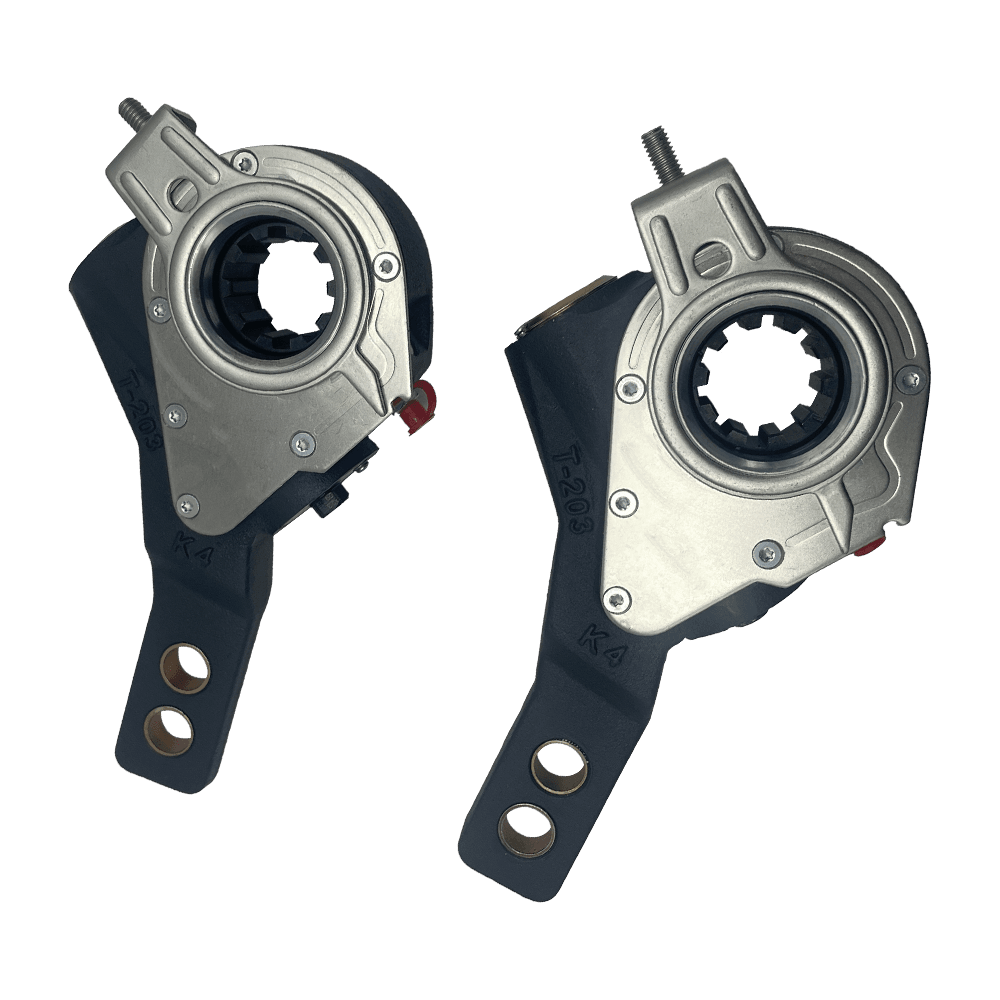
Manual vs Automatic Failure Modes
On older vehicles with manual slack adjusters, failure to adjust is usually the result of human error, since the component must be manually cranked and measured on a regular schedule. On vehicles fitted with an automatic slack adjuster, failure typically stems from an internal mechanical fault, such as a worn clutch mechanism, seized adjustment gear, or damaged control arm, rather than operator neglect. Because automatic units are designed to self-correct every time the brakes are applied, a failure in this system is often a sign that the internal components have physically broken or become contaminated.
Immediate Consequences of an Out-of-Adjustment Slack Adjuster
The effects of a failed adjustment are rarely isolated to one component. They cascade through the entire braking system in ways that are often felt before they are seen.
- Longer stopping distances, since fewer wheels are contributing full braking force
- Uneven brake application, which can cause the vehicle to pull to one side during hard braking
- Increased heat buildup in the remaining functional brakes, accelerating wear on those linings
- Higher risk of brake fade on long descents, since fewer brakes are absorbing the kinetic energy
- Potential for the pushrod to reach the end of its travel, resulting in total loss of braking at that wheel
Out-of-adjustment brakes are one of the most common defects cited during roadside inspections — in some annual inspection programs, brake adjustment issues account for over 40 percent of all out-of-service brake violations.
Warning Signs Drivers Should Never Ignore
Because brake failure at highway speed is so dangerous, learning to recognize the early symptoms of a slack adjuster problem is one of the most valuable skills a driver or fleet technician can develop.
Symptoms During Driving
A soft or spongy brake pedal, a noticeable delay between pressing the brake and feeling deceleration, or a pulling sensation toward one side are all signs that one or more slack adjusters may not be functioning correctly. Unusual grinding, clicking, or clunking noises near the wheel ends can also indicate that the adjustment mechanism is slipping or that internal gearing has failed.
Symptoms During Inspection
During a pre-trip or post-trip inspection, a technician can apply the brakes and measure the distance the pushrod travels. If the stroke exceeds the manufacturer's specified limit, the slack adjuster is out of adjustment. Visible rust, missing dust boots, or a slack adjuster arm that does not return to its resting position after brake release are also red flags that warrant immediate attention.
Warning
Continuing to drive with a suspected out-of-adjustment brake increases stopping distance unpredictably and puts additional strain on the remaining functional brakes.
Common Root Causes of Adjustment Failure
Understanding why a slack adjuster stops working correctly helps drivers and maintenance teams address the problem at its source rather than repeatedly resetting the symptom.
| Root Cause | Typical Effect | Common Fix |
|---|---|---|
| Internal clutch or gear wear | Adjuster no longer ratchets forward | Replace the unit |
| Corrosion or rust buildup | Arm sticks or moves stiffly | Clean, lubricate, or replace |
| Bent or damaged control arm | Inconsistent or partial adjustment | Inspect and replace |
| Improper installation angle | Excess stroke even when new | Reinstall to specification |
| Water or contaminant intrusion | Internal parts seize | Replace with sealed unit |
Environmental exposure plays a significant role as well. Vehicles that regularly operate in wet, salted, or muddy conditions experience faster corrosion of the internal adjustment gearing, which shortens the effective service life of the unit well below its rated mileage interval.
Why Automatic Systems Reduce This Risk
Since the mid-1990s, regulations in many regions have required new heavy vehicles to be equipped with an automatic slack adjuster rather than a manual one. The reasoning is straightforward: manual units depend entirely on someone remembering to measure and adjust them at the correct interval, and missed adjustments were a leading cause of brake-related crashes.
An automatic unit recalculates the correct stroke length every time the brake pedal is released, using an internal ratchet or worm gear mechanism. This dramatically reduces the number of brakes that fall out of adjustment simply due to missed maintenance. However, automatic does not mean maintenance-free. These units still require periodic inspection because internal wear, corrosion, or a stuck mechanism can prevent the self-adjustment function from working even though the component is technically "automatic."
- Check stroke length manually at each scheduled inspection, even on automatic units
- Listen for a distinct clicking sound during brake application, which confirms the adjuster is actively ratcheting
- Inspect the boot and linkage for cracks, rust, or missing hardware
- Replace any unit that fails to self-adjust after a manual reset, rather than resetting it repeatedly
Special Considerations for Trailers
A slack adjuster trailer configuration presents a unique challenge because trailer brakes are often inspected less frequently than the tractor or towing vehicle, especially on trailers that are dropped and picked up by different drivers. Since trailer axles typically carry a significant portion of the total vehicle weight, an out-of-adjustment trailer brake can have an outsized impact on overall stopping performance, particularly when the trailer is loaded near its rated capacity.
Because trailers are frequently exposed to road spray, standing water, and de-icing chemicals, their slack adjusters are statistically more prone to corrosion-related failure than those on the power unit. Fleet maintenance programs that treat trailer brake inspection as equally important as tractor inspection consistently report fewer roadside violations and fewer emergency repairs.
Info
Trailer brake systems should be inspected on the same schedule as the towing vehicle — not treated as a secondary concern.
What to Do If You Suspect a Failure
If a driver notices any of the warning signs described above, the vehicle should not continue in service until the brake system has been inspected by a qualified technician. Continuing to drive with a suspected out-of-adjustment brake increases stopping distance unpredictably and puts additional strain on the remaining functional brakes, which can lead to a secondary failure.
A technician will typically measure pushrod stroke at each wheel end, compare it against the manufacturer's specification chart, and inspect the physical condition of the adjuster arm and clevis pin. If the unit fails to hold adjustment after being manually reset and re-tested, replacement is almost always the correct solution rather than attempting a temporary repair, since a failing internal mechanism will typically continue to degrade.
Danger
A pushrod that reaches the end of its travel can result in total loss of braking at that wheel. This is not a defect to schedule around — it requires immediate correction.
Preventing Future Adjustment Failures
Most adjustment failures can be avoided with a consistent inspection routine rather than reactive repairs after a problem is already visible.
- Measure brake stroke at every scheduled preventive maintenance interval, not just during annual inspections
- Keep a written record of stroke measurements to identify units that are trending toward failure before they cross the legal limit
- Replace slack adjusters in pairs on the same axle when one shows signs of wear, since the second unit is usually close behind
- Ensure technicians use manufacturer-approved parts and torque specifications during replacement
- Pay closer attention to trailer axles operating in wet or corrosive environments
Success
Fleets that adopt a proactive stroke-measurement program typically see brake-related out-of-service rates drop by a meaningful margin within the first year.
In the end, a slack adjuster is a small, quiet component with an outsized role — the difference between a vehicle that stops predictably and one that doesn't. Treating adjustment as a routine measurement rather than an afterthought is what separates fleets that catch failures early from those that discover them the hard way, on the road, when it matters most.


