
 English
 русский
 Español
 Deutsch

Field Guide — Brake Mechanics
A straight push of air becomes a rotating force strong enough to stop tons of steel. Here is the mechanical translation that happens inside every wheel end, and why a few degrees of angle decide how well it works.
The Direct Answer
A slack adjuster converts the linear force produced by the brake chamber into rotational torque that turns the brake's S-camshaft, which then forces the brake shoes outward against the drum. In simple terms, the brake chamber pushes in a straight line, but the camshaft needs to rotate to apply the brakes, and the slack adjuster is the mechanical arm that bridges these two very different types of motion. This conversion is not automatic in effect, it depends heavily on the length of the lever arm and the angle at which it operates, which is why technicians must periodically adjust slack adjuster components or adjust automatic slack adjusters to keep this force transfer efficient.
Understanding this conversion process is essential for anyone responsible for vehicle safety, because even a small change in lever geometry can significantly change how much braking force actually reaches the wheel.
The Mechanical Chain From Pedal to Wheel
To understand how a slack adjuster does its job, it helps to trace the full path of force through an air brake system. When the driver presses the brake pedal, compressed air is released into the brake chamber. This air pressure pushes against a diaphragm inside the chamber, which in turn pushes a pushrod outward in a straight line. At this point, the force is entirely linear, meaning it moves in one direction along a single axis.
The problem is that the brake shoes inside the drum do not move in a straight line, they rotate outward from a pivot point. Something has to convert that straight-line push into a rotating motion, and that something is the slack adjuster. The pushrod connects to the end of the slack adjuster arm, and as the pushrod extends, it pivots the arm around the camshaft, causing the shaft itself to rotate.
Why Rotation Matters
Once the camshaft rotates, an S-shaped cam lobe on the shaft presses against rollers or cam followers attached to the brake shoes. This rotation forces the shoes outward against the inside surface of the brake drum, creating the friction that ultimately slows or stops the wheel. Without this rotational conversion, the linear push from the chamber would have no way to apply pressure evenly around the circular drum surface.
adjust slack adjuster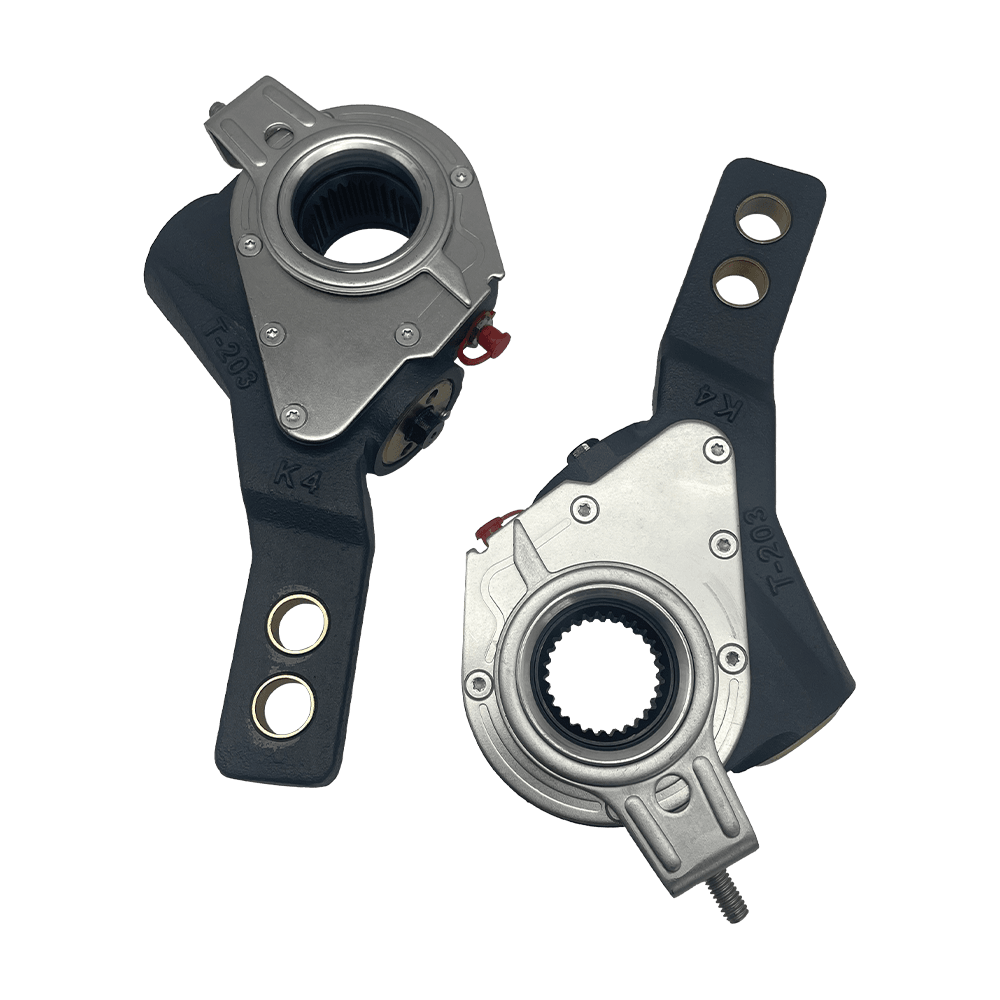
The Physics of Leverage Inside the Slack Adjuster
The slack adjuster works on a simple but powerful mechanical principle: leverage. The arm acts like a lever, and the length of that lever directly determines how much torque is applied to the camshaft for a given amount of pushrod force. A longer effective lever arm produces more torque, but it also requires the pushrod to travel further to achieve the same rotation angle.
This is why the angle between the pushrod and the slack adjuster arm matters so much. Brake engineers generally consider a 90-degree angle between the pushrod and the adjuster arm to be the most efficient position, because at this angle, nearly all of the linear force from the chamber converts directly into rotational torque with minimal loss. As the angle moves away from 90 degrees, in either direction, the mechanical efficiency of the conversion drops, meaning less of the chamber's force actually reaches the brake shoes.
| Pushrod Angle | Approximate Efficiency | Effect on Braking |
|---|---|---|
| 90 degrees | Maximum | Full torque transfer to camshaft |
| 75 to 89 degrees | High, slightly reduced | Minor reduction in braking force |
| 60 to 74 degrees | Moderate | Noticeably weaker brake application |
| Below 60 degrees | Low | Significant loss of braking power |
This is precisely why brake stroke and adjustment matter so much. If a slack adjuster is out of adjustment, the pushrod has to travel further before the shoes contact the drum, which often means the brakes are being applied at an inefficient angle rather than the ideal 90-degree position.
Why Correct Adjustment Is Critical to Force Transfer
Because the geometry of the slack adjuster arm directly determines how efficiently force is converted, keeping the correct adjustment is not just a regulatory requirement, it is fundamental to how well the brakes actually work. When technicians adjust slack adjuster components, they are essentially resetting the resting position of the arm so that the pushrod approaches the ideal 90-degree angle when the brakes are applied.
As brake linings wear down, the shoes need to travel further to reach the drum, which naturally changes the angle at which the pushrod engages the arm during a full stroke. Without correction, this shift moves the system away from peak mechanical efficiency, meaning the same air pressure from the chamber produces progressively less braking torque at the wheel.
The Role of Automatic Adjustment
Modern systems are designed to adjust automatic slack adjusters continuously, using an internal mechanism that senses excess clearance and advances the adjustment gear slightly with each brake application. This keeps the lever arm operating near its optimal angle at all times, without requiring a technician to manually reset it after every brake job. The internal clutch mechanism only allows the adjustment to move in one direction, tightening the clearance, which prevents the system from accidentally loosening itself during normal driving.
Every brake application depends on the same transformation: linear chamber force becomes rotational camshaft torque. The efficiency of that transformation depends entirely on angle and leverage — nothing more, nothing less.
Quantifying the Force Multiplication
The amount of torque a slack adjuster delivers to the camshaft depends on both the force from the chamber and the length of the lever arm. A typical heavy-duty brake chamber can produce several thousand pounds of force at full air pressure, and a slack adjuster arm is generally between five and six inches long. Using basic torque calculations, this means a chamber producing roughly 2,000 pounds of linear force through a 5.5-inch arm can generate over 900 foot-pounds of torque at the camshaft when operating at the ideal angle.
This torque is what ultimately gets converted into clamping force between the brake shoes and the drum. Even a modest reduction in mechanical efficiency, say a 15 percent loss due to poor pushrod angle, translates directly into a proportional loss of clamping force, which is why brake regulators are so strict about maximum allowable stroke length before a brake is considered out of adjustment.
Info
A 15 percent efficiency loss sounds small, but it translates directly into a proportional loss of clamping force at the drum — the math does not forgive poor geometry.
Practical Signs the Conversion Process Is Compromised
Because this force conversion happens out of sight inside the wheel assembly, drivers and technicians need to rely on measurable indicators rather than direct observation to know whether the system is working efficiently.
- Excessive pushrod travel beyond the manufacturer's specified stroke limit
- A soft or delayed brake pedal response despite normal air system pressure
- Visible misalignment between the pushrod clevis and the slack adjuster arm
- Uneven brake temperatures across axles after a highway stop, indicating unequal force distribution
- Audible clicking from the automatic adjustment mechanism without a corresponding reduction in stroke
Warning
Any of these signs suggest the lever geometry has shifted away from its efficient operating range — reducing braking torque even when the chamber itself functions perfectly.
Step-by-Step: How Technicians Restore Proper Force Conversion
Restoring the correct geometry is a fairly precise process, and following the proper sequence helps ensure the slack adjuster returns to its optimal operating angle.
- Release the parking brake and ensure the air system is fully charged so the chamber is not under residual pressure
- Measure the current pushrod stroke by applying the brakes and marking the travel distance at the chamber
- Compare the measurement against the manufacturer's maximum allowable stroke for that chamber size
- On manual units, rotate the adjustment mechanism until the shoe just contacts the drum, then back off slightly to allow proper running clearance
- On automatic units, manually reset the mechanism only if it has failed to self-correct, then verify it resumes normal function on subsequent brake applications
- Re-measure the stroke after adjustment to confirm the pushrod now engages closer to the ideal angle
This process is why routine efforts to adjust slack adjuster geometry, or to verify that a system continues to correctly adjust automatic slack adjusters on its own, are treated as safety-critical maintenance tasks rather than optional upkeep.
Success
Vehicles with well-maintained slack adjusters, verified through regular stroke checks, consistently show more predictable stopping distances and more even brake wear.
Why This Mechanical Principle Still Matters in Modern Fleets
Even with widespread adoption of automatic adjustment technology, the underlying physics of lever conversion have not changed. Every brake application still depends on the same fundamental transformation of linear chamber force into rotational camshaft torque, and the efficiency of that transformation still depends entirely on maintaining the correct arm angle and length ratio.
Fleet maintenance data consistently shows that vehicles with well-maintained slack adjusters experience more predictable stopping distances and more even brake wear across axles. Understanding this force conversion process gives drivers, technicians, and safety managers a clearer picture of why something as small as a lever arm plays such an outsized role in the overall safety of a heavy vehicle's braking system.


