
 English
 русский
 Español
 Deutsch

Fleet Maintenance · Brake Systems
Automatic vs. Manual Slack Adjusters
Which one actually belongs on your fleet — and why the answer isn't just about price.
For the vast majority of commercial fleets, an automatic slack adjuster is the better choice over a manual unit. It reduces labor hours spent on brake checks, lowers the risk of human error during adjustment, and keeps stroke length within a safe operating range without requiring a technician to physically measure and correct it at every inspection interval. Manual slack adjusters still have a place in older equipment, specialty trailers, or budget-constrained operations, but for anyone running a daily fleet where downtime and compliance violations carry real cost, the auto slack adjuster is the standard for good reason.
That said, "better" depends on the specific application. A single owner-operator running one truck with a predictable route has different needs than a fifty-unit fleet with rotating drivers and mixed cargo weights. The rest of this article breaks down exactly where each type excels, where it falls short, and how to decide which one belongs on your equipment.
What a Slack Adjuster Actually Does
A slack adjuster is the mechanical link between the brake chamber pushrod and the S-cam that rotates the brake shoes into contact with the drum. Every time the brakes are applied, the pushrod extends, the slack adjuster rotates the S-cam, and the shoes press outward. Over time, the friction material on the shoes wears down, which means the pushrod has to travel farther to achieve the same braking force. This growing travel distance is called "stroke," and if it exceeds the manufacturer's specified limit, braking performance drops sharply and stopping distances increase.
slack adjuster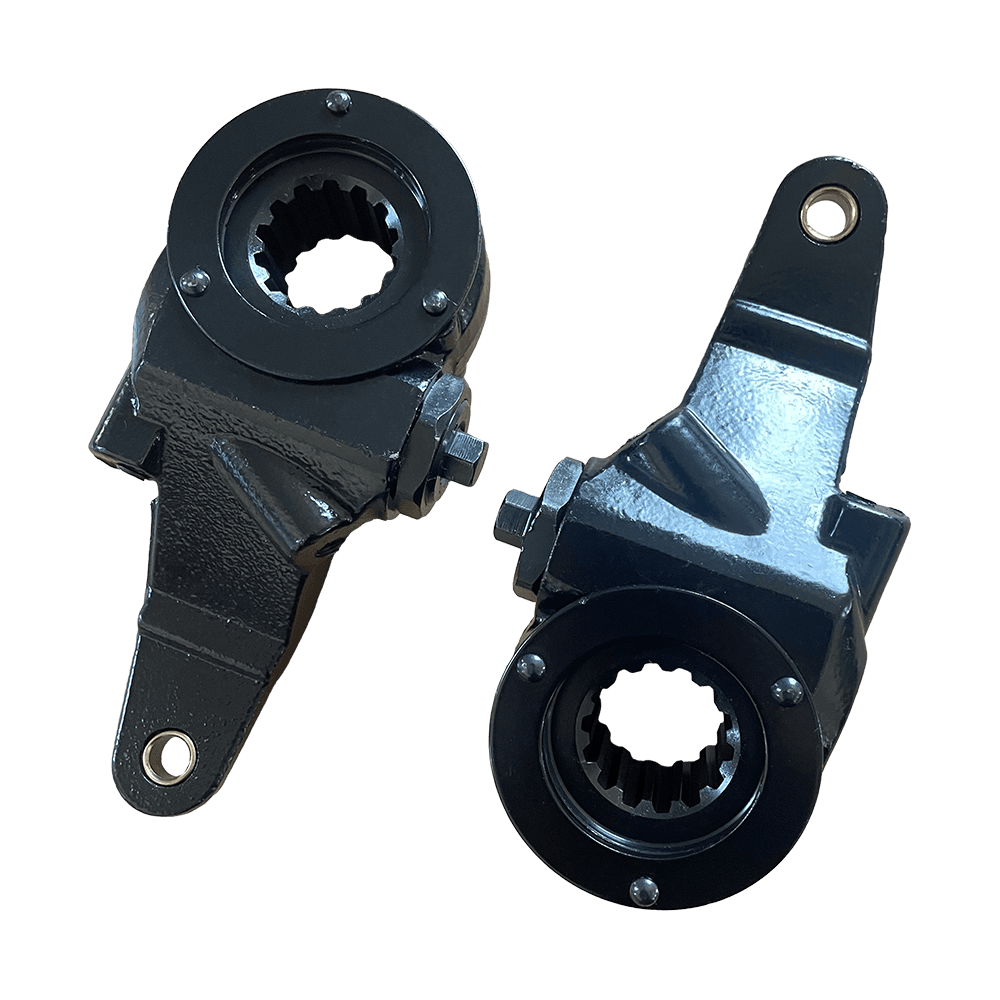
The core job of any slack adjuster on a truck is to compensate for that wear, either by requiring a technician to manually reset the arm length or by automatically taking up the slack internally as the lining wears. This single function has an outsized impact on roadside inspection outcomes, since out-of-adjustment brakes remain one of the most frequently cited violations in commercial vehicle inspections.
How Manual Slack Adjusters Work
A manual slack adjuster requires a technician to periodically check pushrod travel with a ruler or gauge, then use a wrench to turn an adjusting bolt or worm gear until the stroke returns to spec. There is no internal mechanism that compensates for lining wear automatically — every adjustment is a deliberate, hands-on task.
Advantages of Manual Units
- Lower upfront purchase price, often less than half the cost of an automatic unit
- Simple mechanical design with fewer internal components to fail
- Easier to source replacement parts for older trailers still in service
Drawbacks of Manual Units
- Requires consistent, scheduled adjustment — skipped checks lead to brake fade
- Adjustment quality depends entirely on technician skill and diligence
- Higher likelihood of failed roadside brake inspections if maintenance lapses
How Automatic Slack Adjusters Work
An auto slack adjuster contains an internal clutch and worm gear mechanism that senses excess pushrod travel during braking and incrementally corrects the arm angle without any manual intervention. Each time the brakes are applied beyond a preset travel threshold, the mechanism ratchets forward slightly, keeping stroke length within a narrow, consistent range throughout the life of the brake lining.
Advantages of Automatic Units
- Continuous self-adjustment reduces the chance of out-of-spec stroke length
- Significantly less technician time spent on routine brake adjustment
- More consistent braking performance across all axle positions
- Required equipment on most new commercial trucks and trailers manufactured in recent decades
Drawbacks of Automatic Units
- Higher initial component cost compared to manual versions
- Internal clutch mechanism can seize or fail from corrosion if not periodically lubricated
- Technicians can develop a false sense of security and skip visual inspections entirely
Side-by-Side Comparison for Fleet Decision-Making
The table below summarizes the practical differences fleet managers weigh most heavily when choosing between the two types.
| Factor | Manual Slack Adjuster | Automatic Slack Adjuster |
|---|---|---|
| Upfront Cost | Lower | Higher |
| Labor Required | Frequent manual checks | Minimal, periodic verification only |
| Consistency of Adjustment | Depends on technician diligence | Consistent across brake applications |
| Roadside Inspection Risk | Higher if checks are skipped | Lower under normal operation |
| Best Suited For | Older trailers, low-mileage units | Daily-use fleets, high-mileage operations |
T[he Real Cost Difference Over the Life of a Fleet
Fleet managers often focus on the purchase price gap between manual and automatic units, but that comparison misses the bigger picture. A manual slack adjuster on a truck might cost noticeably less to buy, but the labor required to check and adjust it — typically every service interval, and more often for trucks running mixed terrain or heavy loads — adds up quickly across a multi-unit fleet.
An automatic unit shifts the cost structure entirely: the higher purchase price is offset by reduced technician hours, fewer missed adjustments, and lower exposure to out-of-service violations.
For fleets running dozens of vehicles, the labor savings alone often justify the switch within the first one to two years of service.
Safety and Compliance Considerations
Brake adjustment violations remain one of the most common reasons commercial vehicles are placed out of service during roadside inspections. A truck with even one axle out of adjustment can fail an inspection outright, regardless of how well the rest of the vehicle is maintained.
Automatic units are not immune to failure, but they remove the single largest point of human error from the equation: forgetting or delaying a scheduled adjustment. Fleets that have transitioned entirely to automatic slack adjusters typically report fewer brake-related inspection violations, since the mechanism is actively correcting stroke length on every application rather than waiting for the next scheduled check.
Don't skip inspections on automatic units
Technicians should still perform a visual and functional check at every preventive maintenance interval to confirm the clutch mechanism is engaging properly and the arm isn't seized from corrosion or debris buildup, particularly on vehicles that operate in wet, salted, or off-road conditions.
When a Manual Slack Adjuster Still Makes Sense
Despite the clear advantages of automatic units, manual slack adjusters aren't obsolete. They remain a practical choice in a few specific scenarios:
- Older trailers built before automatic units became standard equipment, where retrofitting the entire brake system isn't cost-effective
- Low-mileage or seasonal equipment that sits idle for extended periods, where automatic mechanisms are more prone to seizing from disuse
- Budget-constrained operations replacing a single failed unit on a trailer that will be retired within a short timeframe
Default to automatic where practical
Outside of these situations, most maintenance managers now default to automatic units as the standard replacement, even when swapping a single component on an older trailer, simply because the cost premium is modest relative to the reduction in ongoing labor and compliance risk.
Maintenance Best Practices Regardless of Type
Whether a fleet runs manual or automatic units, a few maintenance habits significantly extend component life and reduce failure risk:
- Lubricate the slack adjuster at every scheduled service interval to prevent internal corrosion
- Visually inspect the arm and clevis pin for excessive play or bending after any hard braking event
- Measure pushrod stroke periodically even on automatic units to confirm the mechanism is functioning correctly
- Replace matched pairs on the same axle rather than mixing old and new components
The most common cause of premature failure
Neglecting these steps is one of the most common reasons even a properly specified automatic unit ends up failing prematurely, undermining the very reliability advantage it's meant to provide.
Making the Final Call for Your Fleet
For nearly every active commercial fleet, an automatic slack adjuster delivers a stronger return on investment than a manual unit once labor costs, compliance risk, and driver safety are factored in together. The higher purchase price is a small trade-off against the reduced likelihood of an out-of-adjustment brake violation shutting down a truck mid-route.
The bottom line
Manual units still hold a narrow but legitimate place for older or low-utilization equipment where the cost of upgrading the entire brake assembly doesn't align with the vehicle's remaining service life. The right decision ultimately comes down to matching the component to how hard, how often, and how consistently a truck or trailer is actually used.


